
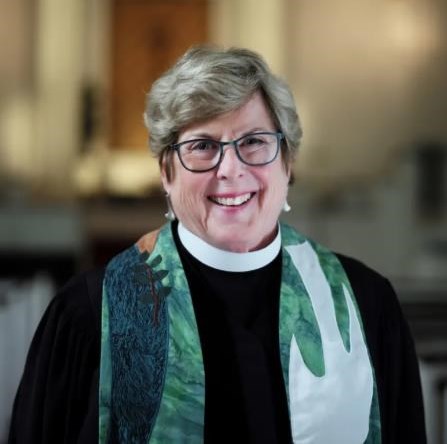
Today, as Our House mourns the loss of the Rev. Dr. Joanna Moseley Adams, we find ourselves returning to the conversation that ultimately led her to open our first doors.
It began with a seemingly impossible question.
In 1987, a member of North Decatur Presbyterian Church came to her pastor, the Rev. Joanna Adams, shaken by what she had been required to do while volunteering at a nearby emergency shelter. She’d been asked to wake families before the sun was up and send mothers and young children out into the predawn world with instructions not to return until evening, regardless of the weather, whether a child was sick or whether the family had anywhere else to go.
“Where in the world are that mother and baby going?” the woman asked. “They have no place to go. No place to go in all of DeKalb County.”
The question haunted Joanna, so she picked up the phone.
She began calling people who could help her find the answer, and before long volunteers from congregations and community organizations across DeKalb County were raising money and building support for something families desperately needed: free, reliable childcare for young children experiencing homelessness.
The problem they were facing was painfully practical. Parents were expected to search for jobs and housing during the day, but many had nowhere safe to leave their children. A mother could not reasonably look for work while carrying a toddler from place to place, nor could she keep the job she found without dependable childcare.
Within nine months, the community had raised the resources and found a place to put that belief into practice. In March 1988, Our House opened its doors.
Joanna later called it “an absolute miracle.”
When Columbia Theological Seminary wrote about the young organization in 1989, Joanna described a commitment that had already shaped years of her ministry.
“Homelessness has been my passion,” she said. “It has shaped my ministry and life for 10 years.”
Six years after Our House opened, Joanna learned that new mothers were leaving Atlanta hospitals with their newborns and nowhere safe to go. She partnered with her longtime friend Rabbi Alvin Sugarman and helped unite 16 faith communities to create Genesis Shelter.
Genesis opened in 1994 and served more than 3,000 people before merging with Our House in 2014.
Once again, Joanna had encountered a gap that left families vulnerable, and her response was to bring people together and do something about it. Our House and Genesis met different needs, but both grew from the same conviction that compassion alone is not enough, and that feeling something deeply requires doing our part to right a wrong.
Joanna became one of the most respected Presbyterian ministers of her generation, a pioneering woman in church leadership and a powerful voice on poverty, racism, homelessness and justice. Those who knew her also remember someone who was funny, fearless and refreshingly without pretension, a woman who loved her family and friendships deeply and understood that relationships were often where difficult work began.
Her decades-long friendship and collaboration with Rabbi Sugarman reflected that belief. Later, through Higher Ground, she joined Rabbi Sugarman, Imam Plemon El-Amin and the Rev. Joseph Roberts in bringing Christian, Jewish and Muslim leaders together to confront some of Atlanta’s most difficult issues.
Joanna understood that the problems she cared about were too large and too deeply rooted for any one person, congregation or organization to solve. Homelessness, poverty, racism and inequality had been shaped by systems and inequities generations in the making. Addressing them required people willing to resist judgment and work together toward something better.
Equal parts courage and compassion, she fought tenaciously for people who were too often overlooked while challenging the rest of us to recognize that a community cannot thrive while some of its members are left behind. She taught this city to see the struggles of its most vulnerable families as a call to our shared humanity and responsibility.
Nearly four decades later, the solution Joanna helped create has grown in ways she could not have initially imagined. What began as free childcare became a trauma-informed network of early childhood education, long-term shelter, comprehensive healthcare, employment training and family advocacy serving thousands of people and families a year, and giving them the hand up they need to achieve the kind of lasting stability that echoes for generations.
She may not have foreseen the scale of what Our House would become, but she understood the underpinnings of the work and the importance of looking beyond the initial crisis, understanding what is keeping a family from moving forward, and helping people overcome systemic barriers.
That lesson and her spirit still fill the halls of Our House today. We feel it when a parent heads to work knowing a child is safe in one of our classrooms; when a mother and newborn leave the hospital and have somewhere warm to sleep; and when a healthcare provider recognizes a concern before it becomes a crisis.
Thousands of children and families have come through our doors since Joanna helped open them. While most never knew her, they have directly experienced and benefited from her belief that dignity can take the form of practical care, and that communities working together can change circumstances that once seemed insurmountable.
We extend our deepest condolences to Joanna’s husband, Al, their children and grandchildren, her congregations and colleagues, and the many people who knew her as pastor, teacher, advocate, mentor and friend.
In our mourning, we also inherit a responsibility from her.
There will always be another need that seems too large, another inequity that has persisted too long and another family confronting circumstances they never imagined. Joanna taught us to turn toward them, to pay closer attention, to bring more people to the table and to find the part of the problem we can help change.
That is her sermon, and nearly four decades later, it is still being preached.